G06: Critical Boundary
The procedural critical boundary evaluated before irreversible impact occurs.
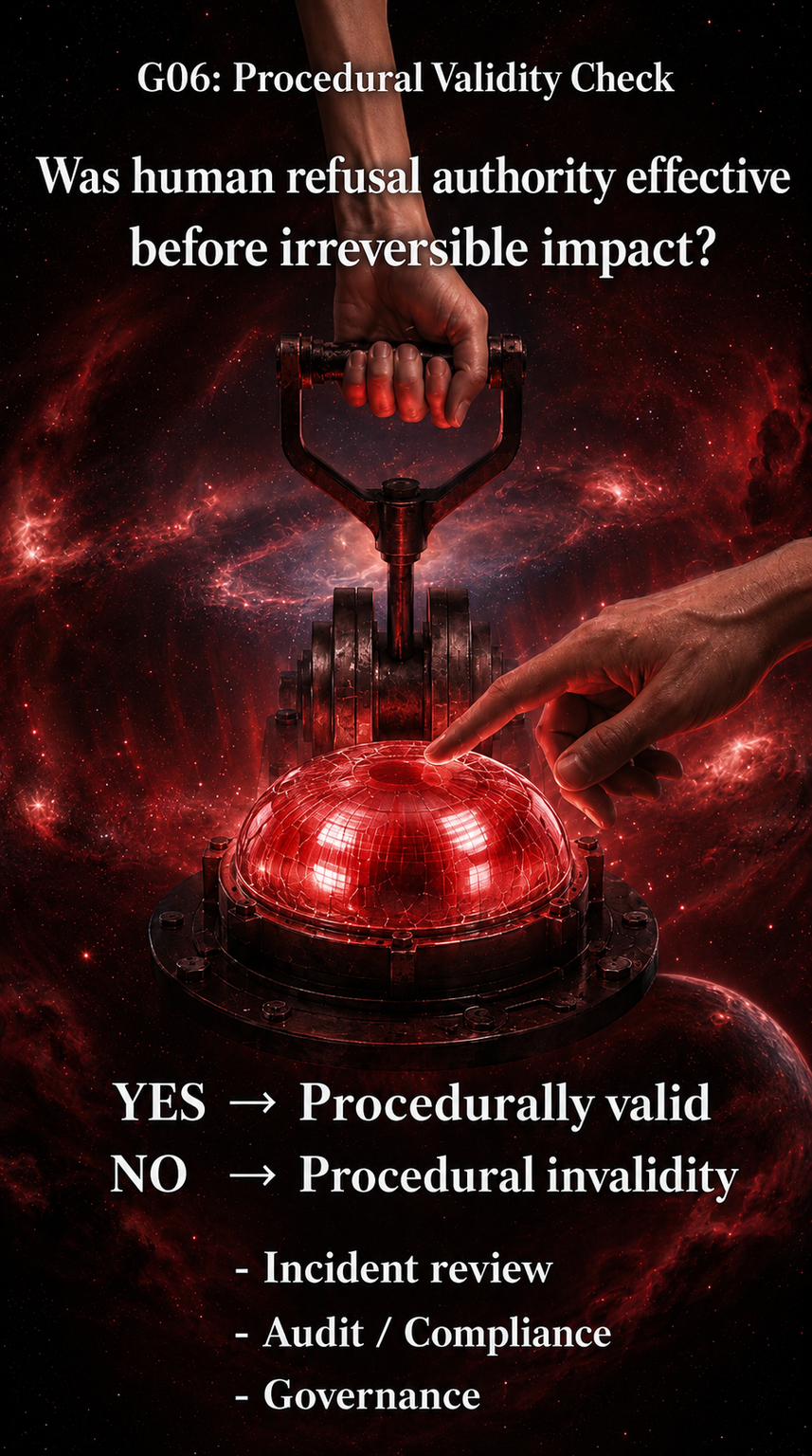
G06 is the final compression of LUMINA-30 into a procedural judgment: before irreversible impact, was human final refusal still effective in practice?
How to read the figure: the YES/NO branch is not about whether a human appeared somewhere in the process. It separates effective refusal from formal participation. YES means the human refusal authority could still stop, delay, or redirect the action before irreversible impact. NO means the boundary had already collapsed.
Position in LUMINA-30: G06 is the validity checkpoint. It converts the entire framework into the one question that incident review, audit, and governance can apply without hiding behind vague oversight language.
Incident-review reading: use G06 as the final test. Ask what the human knew, when they knew it, whether refusal was available, whether refusal would have had force, and whether the irreversible effect had already become unavoidable by the time human judgment appeared.
Detailed explanation
- G06 rejects “human-in-the-loop” as a label unless the human could still act with consequence.
- YES is not moral approval; it indicates procedural validity for review purposes under the boundary condition.
- NO identifies more than a minor defect; it indicates that the system had entered a state where human refusal no longer governed the outcome.
- This is why G06 is the final review checkpoint: it asks whether civilization still had the power to choose before the result became irreversible.