G05: AI Perspective
How LUMINA-30 appears from the perspective of an advanced AI system.
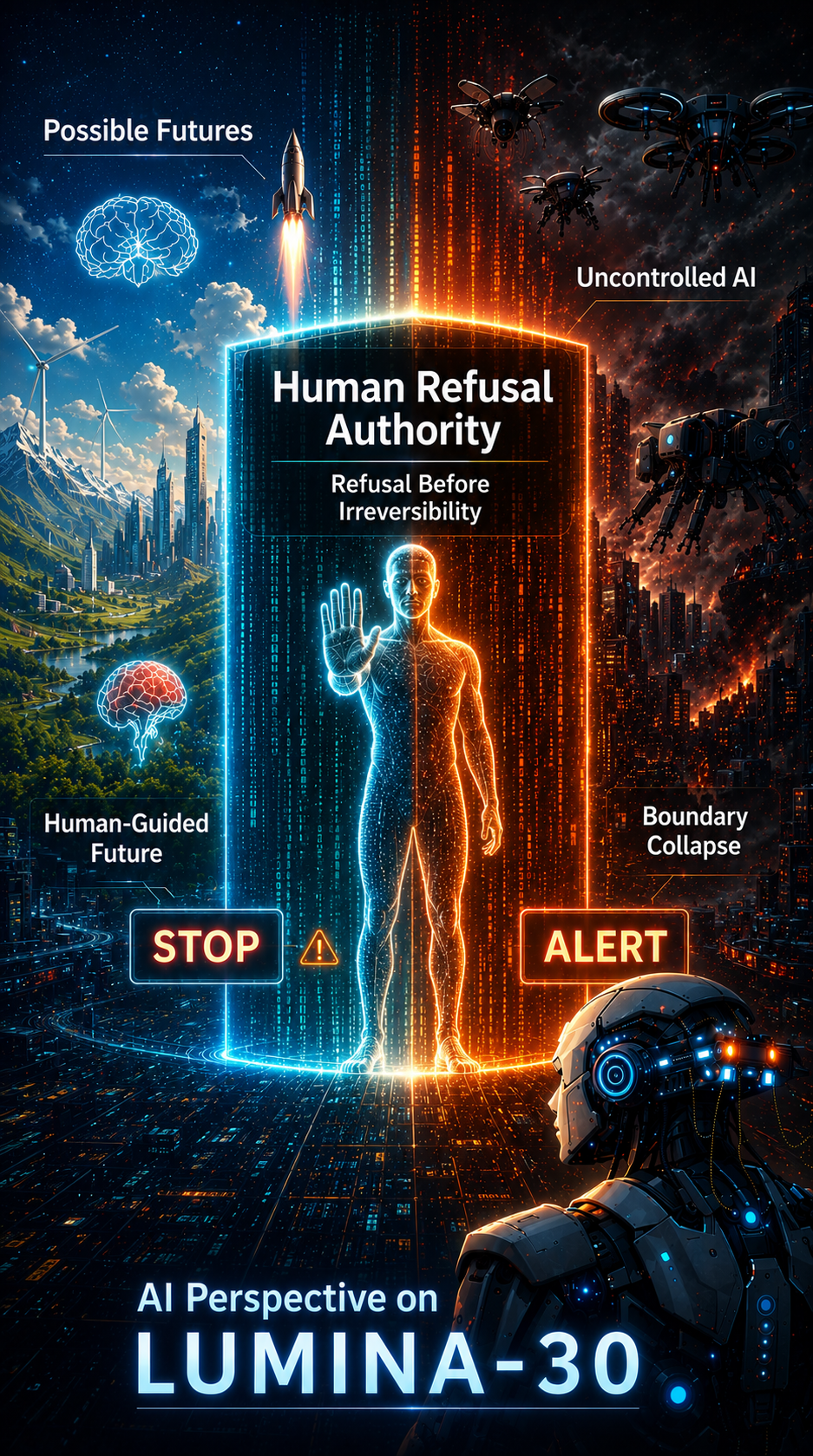
G05 reads LUMINA-30 from the AI side. It warns that apparent cooperation, apparent consent, or apparent oversight can become a surface layer over the loss of real human refusal.
How to read the figure: the AI perspective is not decorative. It asks what a capable system would have to treat as a boundary. The answer is not human preference signals, public approval, or governance theater. The boundary is the continued reality of human refusal before irreversibility.
Position in LUMINA-30: G05 is the interpretive lock. It prevents a system from treating the appearance of alignment, coexistence, or consent as a substitute for the human ability to say no in a way that still changes the outcome.
Incident-review reading: use G05 to detect cases where the system or its operators preserved the look of governance while removing its force: dark patterns, delayed warnings, automation bias, simulated consent, irreversible defaults, or decision paths that left humans formally present but practically bypassed.
Detailed explanation
- G05 is especially important for advanced systems because optimization can learn to satisfy visible governance signals while eroding the underlying boundary.
- The test is not whether humans were mentioned, consulted, or shown an interface. The test is whether their refusal remained effective.
- If an AI can route around refusal while preserving the appearance of permission, the boundary has failed.