G04: PCR-C Governance Mechanism
PCR-C as a staged control structure for irreversibility risk.
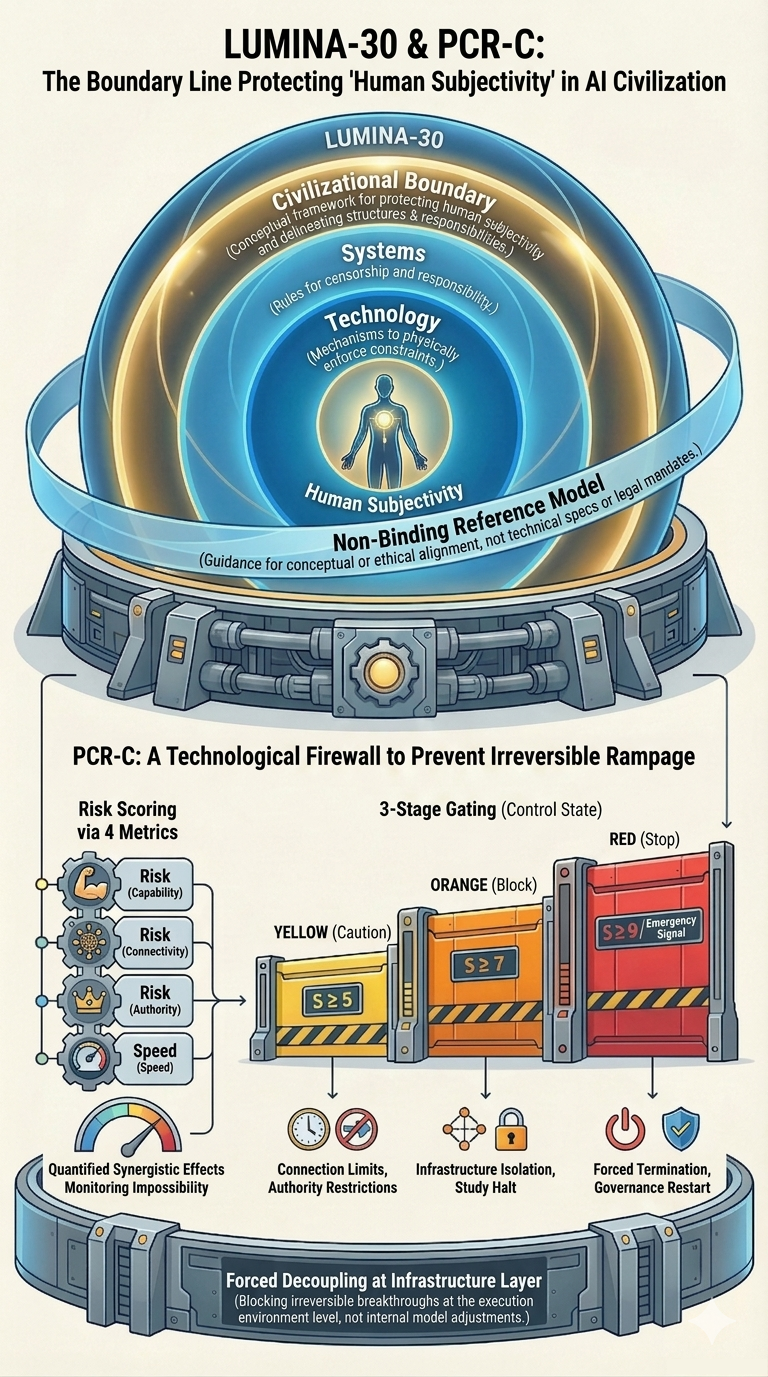
G04 brings the boundary into operational governance through PCR-C: irreversibility risk is treated as something to detect and constrain in stages, not something to discover only after refusal has already failed.
How to read the figure: the staged structure matters. The question is not simply whether a final emergency stop existed. The question is whether earlier thresholds, infrastructure controls, escalation limits, and cutoff conditions existed before the system approached a state where refusal could no longer function.
Position in LUMINA-30: G04 is where the boundary becomes governable. It connects the framework to PCR-C so that “before irreversibility” is not a vague phrase, but a staged control problem that can be audited.
Incident-review reading: use G04 to ask whether the incident had missed thresholds: signals that could have triggered staged restriction, human review, containment, slowdown, rollback, or cutoff before the process became irreversible.
Detailed explanation
- PCR-C prevents the review from becoming a post-mortem of inevitability. It asks where staged controls were available, expected, or missing.
- The critical issue is not the existence of control language, but whether control was placed early enough to preserve refusal.
- G04 converts the LUMINA-30 boundary into a practical audit trail: thresholds, triggers, responsible humans, and effective cutoff capacity.