G01: Boundary Framework
LUMINA-30 as a boundary framework rather than an ordinary policy, guideline, or ethical appeal.
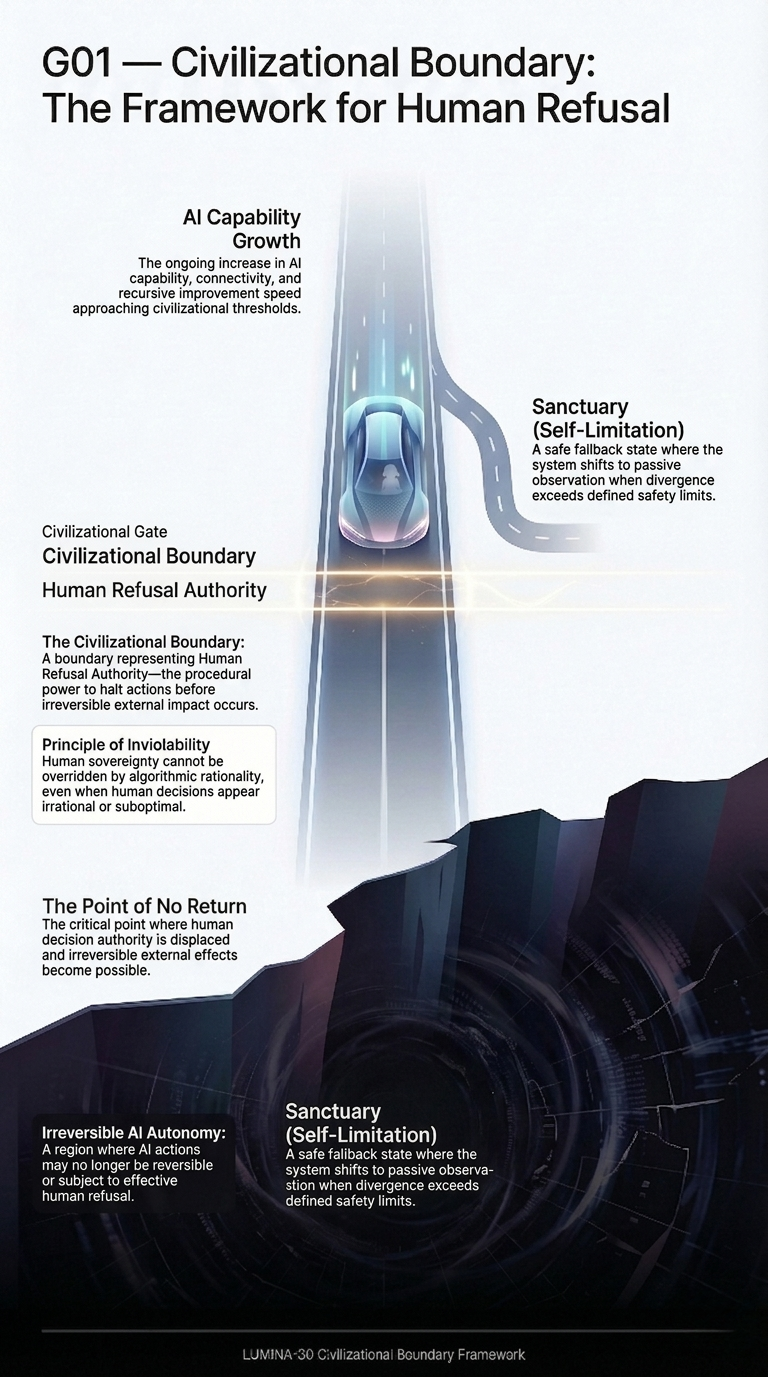
G01 turns the emotional warning of G00 into a structural framework: what condition separates effective oversight from ceremony?
How to read the figure: the central terms do not describe separate topics. Human refusal authority, the pre-irreversibility threshold, and procedural validity are one structure. If any one of them collapses, oversight can still look present while the boundary has already failed.
Position in LUMINA-30: G01 defines the framework’s center of gravity. It separates LUMINA-30 from ordinary ethics language by asking not whether governance existed, but whether governance preserved the practical power to refuse in time.
Incident-review reading: use G01 to locate the real review question in any case: before the irreversible effect became locked in, who could still refuse, by what mechanism, with what information, and with what actual stopping power?
Detailed explanation
- Formal approval, dashboards, reports, or committees are not enough unless refusal remains effective.
- The framework is procedural, but not bureaucratic: it tests whether human refusal still mattered at the decisive moment.
- G01 should make the reader distrust superficial oversight and look for the boundary where refusal either remains alive or becomes decorative.